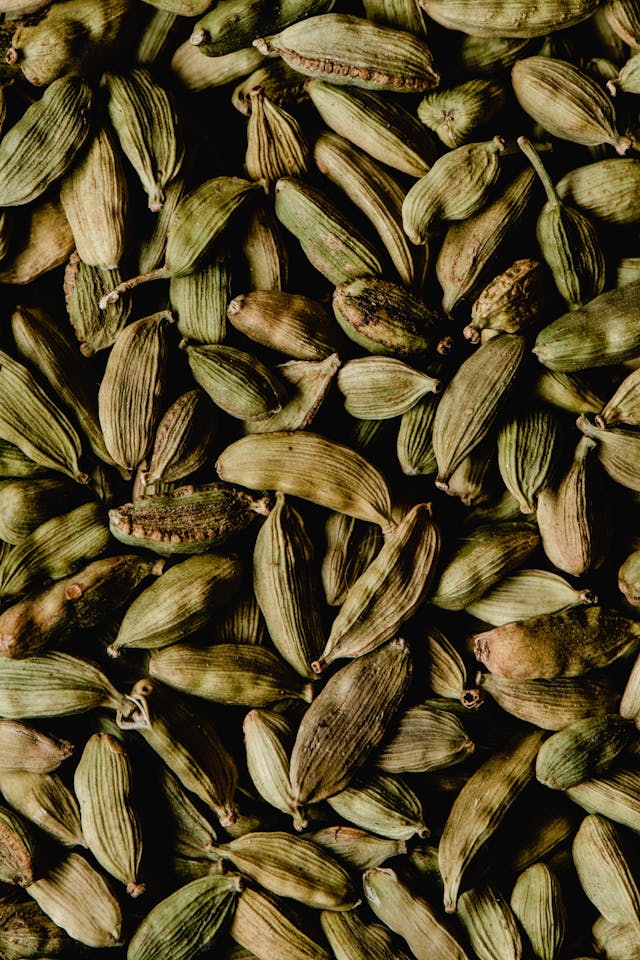
Green cardamom is proof that a tiny ingredient can make tea, kheer or fruit smell finished before it even reaches the table.
What you get from 4 pods (about 0.8 g seeds)
| Energy | 2 kcal |
| Protein | 0.1 g |
| Carbohydrate | 0.5 g |
| Fat | 0.1 g |
| Fibre | 0.2 g |
Source: USDA FoodData Central – www.fdc.nal.usda.gov. Values are approximate and may vary by variety and preparation.
| Read the numbers this wayThis serving gives a small macronutrient contribution in the serving normally used. The more important story is what its key nutrients do once the ingredient becomes part of a complete meal. |
Why it earns a place
Its contribution is mainly aromatic compounds rather than meaningful calories or vitamins at normal serving sizes. Those aromas can make lightly sweetened food feel richer, which is useful when you are trying to rely less on sugar. Crushing the pods just before use releases far more fragrance than using old pre-ground powder.
Plant compounds: small amounts, repeated often
Polyphenols and related plant compounds help plants defend themselves and can interact with the body’s antioxidant and signalling systems. Their value is most believable as part of a varied diet, not as a reason to take concentrated extracts.
Dietary fibre: smoother digestion and steadier energy
Fibre gives stool enough bulk to move through the gut more easily. It also slows the release of sugar from a meal, so energy arrives more steadily instead of rising and falling all at once.
Who may find this food especially useful
| People who want more flavour without depending on packaged saucesHerbs and spices are especially useful when someone is trying to reduce excess salt, sugar or heavy sauces. Culinary amounts can make simple food easier to repeat, which is usually more valuable than concentrated supplements. |
What needs context
| The limitation worth knowingClaims about cardamom treating blood pressure or digestive disease come largely from small or preliminary studies. Culinary use is sensible; concentrated supplements need more caution. |
Try this next time
Cardamom milk
Warm 1 cup milk with 1 crushed cardamom pod. Sweeten lightly only if needed.
Source: Elaichi Milk – www.tarladalal.com
Conversely, black cardamom does not disappear politely into a dish. Its smoky aroma can make a pot of dal or rice taste as though it cooked for hours.
What you get from 1 pod (about 1 g)
| Energy | 3 kcal |
| Protein | 0.1 g |
| Carbohydrate | 0.7 g |
| Fat | 0.1 g |
| Fibre | 0.3 g |
Source: USDA FoodData Central – www.fdc.nal.usda.gov. Values are approximate and may vary by variety and preparation.
| Read the numbers this wayThis serving gives a small macronutrient contribution in the serving normally used. The more important story is what its key nutrients do once the ingredient becomes part of a complete meal. |
Why it earns a place
Like green cardamom, its role is mainly sensory. Strong aroma lets you create depth without needing excessive salt, cream or packaged flavouring. It works best in slow-cooked savoury dishes where one pod can perfume the whole pot.
Plant compounds: small amounts, repeated often
Polyphenols and related plant compounds help plants defend themselves and can interact with the body’s antioxidant and signalling systems. Their value is most believable as part of a varied diet, not as a reason to take concentrated extracts.
Sodium: necessary, but easy to overshoot
Sodium helps nerves and muscles work and keeps fluid balanced. Too much holds extra water in the bloodstream, which can raise blood pressure and increase the heart’s workload.
Who may find this food especially useful
| People who want more flavour without depending on packaged saucesHerbs and spices are especially useful when someone is trying to reduce excess salt, sugar or heavy sauces. Culinary amounts can make simple food easier to repeat, which is usually more valuable than concentrated supplements. |
What needs context
| The limitation worth knowingRemove the pod before serving if the texture is unpleasant. Evidence for medicinal claims is limited, and essential oils should not be swallowed casually. |
Try this next time
Black-cardamom dal
Add 1 lightly crushed black cardamom pod while simmering 2 cups of dal; remove before serving.
Source: Dal Bukhara flavouring method – www.vegrecipesofindia.com